
Introduction
Scaling a digital product today isn’t just about writing code. It’s about speed, clarity, flexibility, and alignment with real user needs.
Too many founders and businesses still struggle with:
- Over-engineered SaaS products that are hard to maintain
- AI dashboards that look impressive but don’t solve real problems
- Web apps that work today—but collapse when traffic or complexity grows
That’s where vibe coding changes the game.
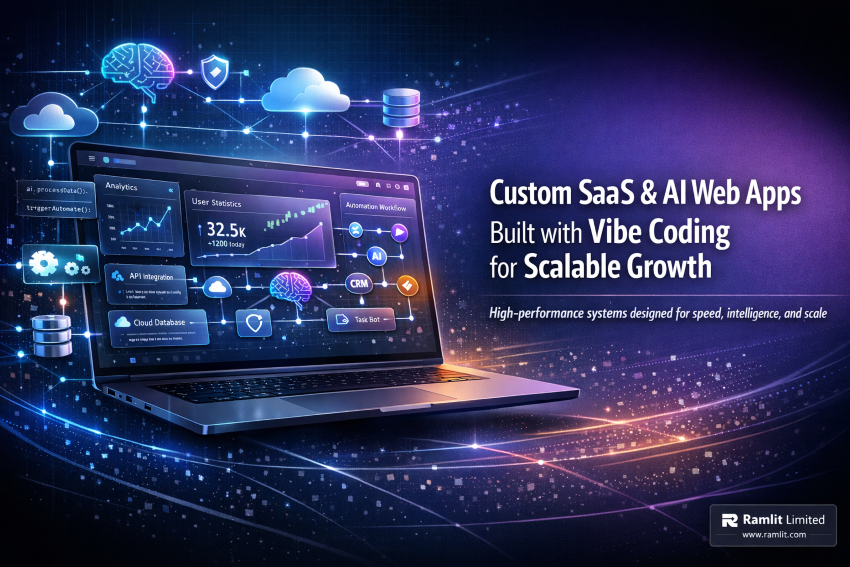
Custom SaaS and AI web apps built with vibe coding focus on flow, intent, and outcomes—not just features. It’s a modern development approach that blends clean architecture, AI integration, rapid iteration, and user-centric design to create products that actually scale.
In this guide, you’ll learn:
- What vibe coding really means (beyond the buzzword)
- Why it’s becoming the go-to approach for scalable SaaS and AI products
- How custom-built AI web apps outperform templates and no-code tools
- What to expect when building your SaaS or AI dashboard the right way
- How to avoid common mistakes that kill growth early
If you’re serious about building a future-ready SaaS or AI-powered web app, this article is for you.
What Is Vibe Coding (And Why It Matters for SaaS & AI Apps)
Vibe coding isn’t about cutting corners. It’s about coding with intention.
At its core, vibe coding means:
- Writing code that’s clean, modular, and scalable from day one
- Aligning technical decisions with business goals and user behavior
- Building fast without sacrificing long-term maintainability
- Using AI tools and modern frameworks intelligently—not blindly
Instead of asking “What features can we add?”, vibe coding asks:
“What experience are we creating, and how will it scale?”
For SaaS platforms and AI web apps, this mindset is critical. Growth exposes weaknesses fast—poor architecture, messy logic, and rushed integrations show up the moment users increase.
Vibe coding prevents that.
Why Custom SaaS Still Beats Templates and No-Code Tools
No-code and low-code tools are tempting. They promise speed, simplicity, and low upfront cost.
But here’s the reality:
- They limit customization
- They struggle with complex AI workflows
- They become expensive or restrictive as you scale
- You don’t fully own the architecture
Custom SaaS development with vibe coding gives you:
- Full control over features and integrations
- AI logic tailored to your use case (not generic workflows)
- Better performance and security
- A foundation built for real growth, not hacks
Templates help you start. Custom development helps you scale.
The Role of AI in Modern SaaS & Web Applications
AI is no longer optional—it’s expected.
Modern SaaS products use AI for:
- Smart dashboards and analytics
- Automation and decision support
- Personalized user experiences
- Chatbots and assistants
- Predictive insights
But AI done wrong creates confusion, slow systems, and mistrust.
Vibe coding ensures AI is:
- Integrated with purpose
- Transparent and explainable where needed
- Optimized for performance
- Designed around real user workflows
Instead of bolting AI on top, it becomes part of the product’s DNA.
Building Scalable Architecture from Day One
Scalability isn’t something you “add later.” It’s something you design for upfront.
With vibe coding, scalability is built into:
- Database structure
- API design
- Authentication and authorization
- Cloud infrastructure
- Modular services
This means your SaaS or AI web app can handle:
- More users
- More data
- More features
- More integrations
Without needing a painful rewrite six months later.
AI Dashboards That Actually Drive Decisions
Many AI dashboards look impressive—but fail in practice.
Common problems:
- Too much data, not enough clarity
- Poor UX that overwhelms users
- Insights without context or action
Vibe-coded AI dashboards focus on:
- Clear metrics aligned with business goals
- Visual hierarchy and simplicity
- Real-time or near-real-time insights
- Actionable outputs, not just charts
A good AI dashboard doesn’t show everything. It shows what matters most.
From MVP to Enterprise: One Codebase, One Vision
A common fear founders have:
“If we build fast now, will we regret it later?”
With vibe coding, the answer is no—if done correctly.
You can:
- Launch a lean MVP quickly
- Validate the market
- Iterate based on real feedback
- Scale into a full-featured platform
All without throwing away your original codebase.
This is how modern startups move fast without breaking things.
Security, Performance, and Trust
Trust is currency in SaaS.
Users expect:
- Secure authentication
- Protected data
- Fast load times
- Reliable uptime
Vibe coding treats security and performance as first-class concerns:
- Secure API design
- Role-based access control
- Optimized queries and caching
- Cloud-native deployment strategies
Because growth means nothing if users don’t trust your platform.
Competitor Reality: Why Many SaaS Products Stall
Here’s the uncomfortable truth: Many SaaS products don’t fail because of bad ideas.
They fail because:
- The tech stack couldn’t keep up
- Development became slow and expensive
- AI features were shallow or unreliable
- The product became hard to evolve
Custom SaaS and AI web apps built with vibe coding avoid these traps by staying flexible, intentional, and user-driven.
The Human Side of Vibe Coding
Good software isn’t just technical—it’s emotional.
Vibe coding pays attention to:
- How users feel using your product
- Friction points and frustration
- Delight moments and flow
- Long-term engagement
When users enjoy your product, growth becomes organic.
Bullet Points / Quick Takeaways
- Custom SaaS beats templates when scalability matters
- AI works best when built into the core, not added later
- Vibe coding balances speed and long-term stability
- Clean architecture saves time and money over time
- Scalable growth starts with intentional development
- Better UX leads to better retention and conversions
Call to Action (CTA)
If you’re planning to build—or rebuild—a SaaS platform, AI dashboard, or web app, now is the time to do it right.
Whether you’re launching an MVP or scaling an existing product, custom SaaS and AI web apps built with vibe coding give you the clarity, flexibility, and performance modern users expect.
👉 Let’s turn your idea into a scalable, AI-powered product built for real growth.
FAQ Section
What types of SaaS products benefit most from vibe coding?
Any SaaS that expects growth, complex workflows, or AI integration benefits—especially B2B platforms, analytics tools, and AI-driven services.
Is vibe coding suitable for startups?
Yes. It’s ideal for startups because it allows fast MVP development without sacrificing scalability.
Can existing SaaS apps be improved using vibe coding?
Absolutely. Many products are refactored or extended using vibe coding principles to improve performance and maintainability.
How long does it take to build a custom SaaS or AI web app?
Timelines vary by complexity, but vibe coding helps reduce development cycles by focusing on clarity and priorities.
Is custom development expensive?
Upfront costs may be higher than templates, but long-term costs are usually much lower due to better scalability and fewer rewrites.
Final Note on Tone & Intent
This blog was written to:
- Educate without overwhelming
- Build trust without hype
- Sell without sounding salesy
- Speak to real founders, teams, and decision-makers