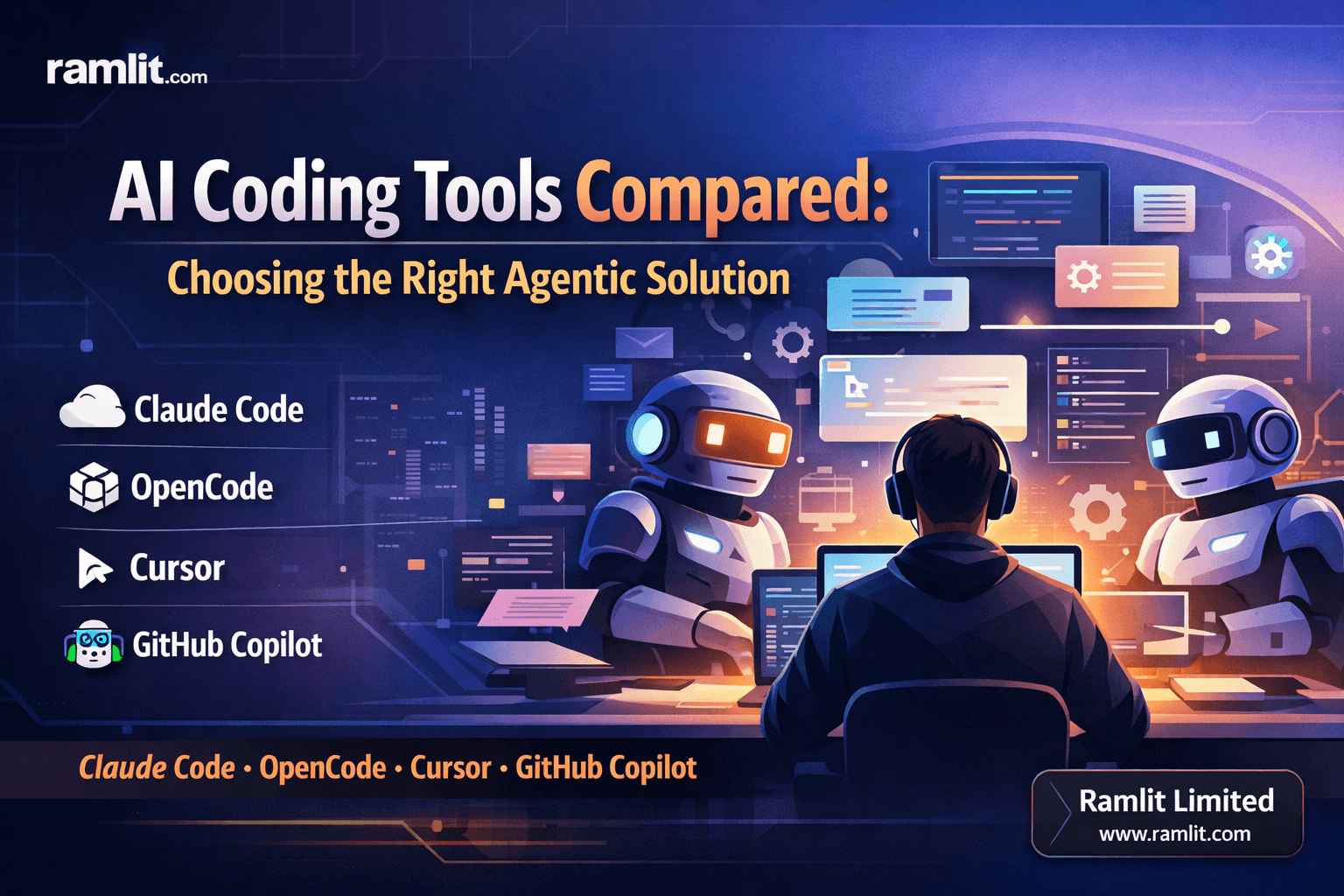

AI Coding Tools Compared: Choosing the Right Agentic Solution
The software development landscape has shifted dramatically. Development teams that once relied solely on human expertise now leverage AI agents that understand context, generate code, and iterate alongside engineers. This isn't a future prediction—organizations deploying agentic coding tools report 40-60% faster feature delivery and significant reductions in debugging time.
But the market has become crowded. Claude Code, OpenCode, Cursor, GitHub Copilot, and emerging players like Gemini CLI each claim superiority. For CTOs and engineering leaders evaluating these tools, the confusion is real. Which platform actually delivers? Which fits enterprise workflows? What are the true cost implications beyond the subscription price?
Ramlit's engineering teams have spent months evaluating these tools across client projects ranging from fintech backends to healthcare platforms. The findings reveal significant differences in capability, integration complexity, and real-world productivity gains. This analysis cuts through the marketing noise and delivers the practical insights decision-makers need.
The Agentic Engineering Paradigm Shift
Traditional AI code assistants provided suggestions. They completed lines, recommended snippets, and occasionally generated functions. Useful, but limited. Agentic engineering tools operate fundamentally differently.
An agentic coding tool doesn't just suggest—it acts. It reads entire codebases, understands project architecture, executes multi-step tasks, and iterates based on results. When an engineer asks an agentic tool to "add user authentication to this application," the agent analyzes existing code structure, identifies the appropriate authentication pattern, generates necessary files, updates configurations, and can even run tests to verify the implementation.
This distinction matters enormously for enterprise adoption. Traditional assistants augment individual developers. Agentic tools can potentially replace entire workflow categories—initial scaffolding, boilerplate generation, test creation, documentation, and routine refactoring. The productivity implications are substantial, but so are the integration challenges.
The current generation of agentic tools splits into two architectural approaches. Terminal-based tools like Claude Code and OpenCode operate through command-line interfaces, treating code generation as a conversational workflow. IDE-integrated tools like Cursor and GitHub Copilot embed intelligence directly into the development environment, providing inline suggestions alongside agentic capabilities.
Neither approach is inherently superior. The choice depends on team workflows, existing tooling, and the specific nature of development work. Understanding these differences is essential before evaluating individual platforms.
Claude Code: Deep Model Integration and Consistent Quality
Anthropic's Claude Code represents a tightly integrated approach to agentic development. Built by the same team that develops Claude's underlying models, Claude Code benefits from optimization that third-party implementations cannot easily replicate.
The platform operates primarily through a terminal interface, though IDE plugins provide integration points for developers preferring graphical environments. Engineers interact with Claude Code through natural language prompts, describing tasks ranging from simple function creation to complex architectural refactoring.
What distinguishes Claude Code is model consistency. Because Anthropic controls both the tool and the underlying AI models (Haiku for speed, Sonnet for balance, Opus for complex reasoning), the integration is seamless. Prompt engineering that works today continues working after model updates. The same cannot always be said for tools that abstract across multiple model providers.
For enterprise teams, this consistency translates to predictability. When Ramlit deploys Claude Code across a project, the quality variance between sessions is minimal. Engineers learn the tool's capabilities and limitations, then reliably operate within them. This predictability matters more than raw capability in production environments where surprises create delays.
Claude Code's skill and agent systems provide extensibility. Teams can define custom workflows—code review protocols, deployment checklists, documentation generators—that become reusable across projects. The memory system maintains context across sessions, reducing the need to re-explain project architecture with each interaction.
The limitation is model flexibility. Claude Code works with Anthropic's models and supports local models through Ollama, but lacks native integration with OpenAI's latest models like GPT-5.2 Codex. For organizations that have standardized on specific model providers, this constraint may matter.
Pricing follows Anthropic's API usage model, with Pro subscriptions offering unlimited usage tiers. For high-volume development teams, the economics favor subscription plans over pure API consumption.
OpenCode: Open Source Flexibility and Multi-Provider Support
OpenCode approaches agentic development from a different philosophy. As an open-source project, it prioritizes flexibility and community contribution over vertical integration.
The platform supports terminal, web UI, and IDE integration modes—the most versatile interface options among current tools. Development teams can standardize on the mode that fits their workflow without switching platforms as needs evolve.
Model support is OpenCode's primary strength. Engineers can seamlessly switch between Anthropic's Claude models, OpenAI's GPT variants, and local models running through Ollama. For organizations with complex procurement requirements or those wanting to avoid vendor lock-in, this flexibility eliminates significant friction.
The open-source nature creates both advantages and considerations. OpenCode's development pace is rapid, with community contributors adding features and fixing issues continuously. However, enterprise support follows a different model than commercial products. The paid OpenCode Black tier provides dedicated support and flat-fee usage, but organizations must evaluate whether community-driven development aligns with their stability requirements.
For development agencies like Ramlit that work across diverse client environments, OpenCode's flexibility proves valuable. Some clients mandate specific AI providers for data governance reasons. Others require air-gapped deployments using local models. OpenCode accommodates these requirements without platform switching.
The agent and skill implementations parallel Claude Code's capabilities but use different configuration patterns. Teams familiar with one platform will find the concepts transferable but the specific implementations distinct. This fragmentation across the ecosystem reflects the technology's immaturity—standardization will likely emerge as the market matures.
Cursor: IDE-Native Intelligence and Superior Auto-Completion
Cursor reimagines the integrated development environment with AI at its core. Rather than bolting AI features onto an existing editor, Cursor builds intelligence into every interaction.
The auto-completion experience stands apart from competitors. Cursor's suggestions appear contextually, understanding not just the current file but the entire project structure. Engineers report that Cursor's completions feel predictive—anticipating the next logical step rather than simply matching patterns.
For teams where coding speed directly impacts delivery timelines, this auto-completion quality translates to measurable productivity gains. Junior developers benefit from suggestions that teach patterns. Senior developers appreciate reduced keystrokes for routine implementations.
Cursor also provides agentic capabilities through its agent mode, allowing multi-step task execution similar to Claude Code and OpenCode. The difference is visual feedback. Cursor shows proposed changes inline, letting engineers accept, modify, or reject each edit before application. This approve-reject workflow provides control that some organizations require for compliance or quality assurance reasons.
Model flexibility matches OpenCode's range. Cursor supports Anthropic, OpenAI, and local models, allowing teams to optimize for cost, capability, or policy requirements across different use cases.
The trade-off is the IDE lock-in. Cursor is a standalone application, not a plugin. Teams using Cursor cannot use their existing VS Code extensions ecosystem without verification, though compatibility is high for common extensions. For organizations with significant investment in custom VS Code configurations, migration requires evaluation.
Cursor's subscription pricing is straightforward, with Pro tiers providing enhanced model access and usage limits appropriate for professional development.
GitHub Copilot: Enterprise Integration and Microsoft Ecosystem Alignment
GitHub Copilot benefits from Microsoft's infrastructure and GitHub's ubiquitous presence in professional development. For organizations already invested in the Microsoft ecosystem—Azure, GitHub Enterprise, VS Code—Copilot offers the smoothest integration path.
The tool operates as a VS Code extension (and extensions for other IDEs), making adoption require minimal workflow changes. Engineers continue using their existing environment while gaining AI assistance.
Copilot's auto-completion capabilities are solid, though Ramlit's engineering teams consistently rate Cursor's suggestions as more contextually accurate. The difference isn't dramatic but compounds across thousands of daily completions.
Agentic capabilities have expanded significantly through Copilot Chat and the agent mode features. Engineers can now request multi-file changes, architectural analysis, and complex refactoring through conversational interfaces. The .github folder structure for skills and configurations follows GitHub's existing patterns, making adoption intuitive for teams familiar with GitHub Actions and workflows.
Model support has broadened beyond initial OpenAI exclusivity. Copilot now supports model selection including Anthropic's Claude, addressing earlier limitations. However, the integration depth with OpenAI models remains superior—a result of Microsoft's partnership with OpenAI.
Enterprise features distinguish Copilot for larger organizations. Policy controls, telemetry options, and administrative dashboards provide the governance capabilities that compliance-focused organizations require. For organizations with hundreds of developers, these management features justify evaluation even if pure capability comparisons favor alternatives.
Pricing follows GitHub's enterprise model, with per-seat subscriptions that scale with team size. For organizations already paying for GitHub Enterprise, Copilot additions are incremental rather than net-new expense categories.
Implementation Guide: Selecting and Deploying the Right Tool
Choosing an agentic coding tool requires matching capabilities to organizational context. The following framework helps structure evaluation.
Evaluate Interface Preferences First
Survey your development team about workflow preferences. Teams heavily invested in terminal workflows—using tmux, vim, or command-line-centric patterns—will find Claude Code and OpenCode more natural. Teams preferring graphical interfaces with visual feedback will gravitate toward Cursor and Copilot.
This preference matters more than feature comparisons. A theoretically superior tool that developers resist using delivers zero productivity gains.
Assess Model Requirements
Determine whether your organization has constraints on AI model usage. Some enterprises mandate specific providers for data governance. Others require local deployment for sensitive codebases. Still others want flexibility to optimize across providers as pricing and capabilities evolve.
If constraints exist, OpenCode and Cursor provide the flexibility needed. If Anthropic's models satisfy all requirements, Claude Code's deeper integration may deliver better results.
Pilot with Real Projects
Abstract evaluations miss the nuances that matter. Deploy each candidate tool on actual project work for 2-4 weeks. Track quantitative metrics—completion time for standard tasks, bug rates in generated code, time spent correcting AI outputs—alongside qualitative feedback from engineers.
Ramlit's evaluation found that tools performing well on benchmark demonstrations sometimes struggled with production codebases featuring legacy patterns, unconventional architectures, or domain-specific conventions. Real project testing exposes these gaps.
Calculate Total Cost of Ownership
Subscription prices are starting points, not total costs. Factor in:
- Integration time and ongoing maintenance
- Training investment for effective usage
- Productivity gains (quantified from pilot data)
- Risk costs from potential vendor changes or discontinuation
Open-source tools like OpenCode may have lower subscription costs but higher self-management overhead. Tightly integrated tools like Claude Code may cost more but require less configuration expertise.
Plan for Ecosystem Evolution
The agentic coding tool market is immature. Standards for configuration files, skill definitions, and agent protocols haven't emerged. Tools that work today may require migration as the ecosystem matures.
Minimize vendor lock-in by documenting custom configurations clearly, avoiding tool-specific patterns where portable alternatives exist, and maintaining awareness of emerging standards. The fragmentation across .claude, .cursor, and .github configuration patterns will likely consolidate—positioning for that transition reduces future migration costs.
Maximizing Results: Beyond Tool Selection
Selecting the right tool is necessary but insufficient. Organizations achieving the highest returns from agentic coding tools share common practices.
Invest in Prompt Engineering Skills
The quality of AI-generated code depends heavily on prompt quality. Vague requests produce generic results. Specific prompts with context, constraints, and examples produce targeted implementations.
Train engineering teams on effective prompt construction. Share prompt patterns that work well within your codebase. Build libraries of reusable prompts for common tasks. This investment multiplies the return on tool subscription costs.
Establish Code Review Protocols
AI-generated code requires review. The question is how much and what kind. Establish clear protocols:
- Which categories of generated code require senior review?
- What security patterns must be verified in generated code?
- How are AI-introduced bugs tracked and addressed?
These protocols prevent the common failure mode where rapid AI generation introduces subtle issues that compound into significant technical debt.
Integrate with Existing Quality Gates
Agentic tools should complement, not bypass, existing quality assurance. Ensure generated code flows through standard CI/CD pipelines, automated testing, and security scanning. Configure agent workflows to run tests automatically after generation, surfacing failures before human review.
Track and Iterate
Measure productivity outcomes continuously. Compare sprint velocities, defect rates, and engineer satisfaction before and after tool deployment. Use data to refine usage patterns, identify training needs, and justify continued investment.
Quantified Tool Comparison
| Capability | Claude Code | OpenCode | Cursor | GitHub Copilot |
|---|---|---|---|---|
| Interface Options | CLI, IDE plugins | CLI, Web, IDE plugins | Standalone IDE | IDE extension |
| Auto-completion Quality | N/A | N/A | Excellent | Good |
| Model Flexibility | Limited (Anthropic + local) | Excellent | Excellent | Good |
| Open Source | No | Yes | No | No |
| Enterprise Management | Basic | Community-driven | Basic | Excellent |
| Integration Depth | Deep (Anthropic models) | Broad but shallow | Deep (IDE-native) | Deep (Microsoft ecosystem) |
| Skill/Agent System | Mature | Developing | Mature | Mature |
| Recommended For | Anthropic-focused teams | Flexibility-prioritized teams | Auto-completion-focused teams | Microsoft ecosystem teams |
The Path Forward for Enterprise Development
Agentic coding tools have moved beyond experimental status. Organizations not evaluating these platforms face competitive disadvantage as early adopters accelerate their development velocity.
The right tool depends on organizational context—existing tooling, team preferences, compliance requirements, and strategic technology partnerships. No single platform dominates across all dimensions.
For enterprises prioritizing quality consistency, Claude Code's tight Anthropic integration delivers reliable results. For those valuing flexibility and avoiding vendor lock-in, OpenCode's open-source model and multi-provider support provides necessary optionality. For teams where auto-completion speed drives productivity, Cursor's IDE-native approach offers measurable advantages. For Microsoft-aligned organizations, GitHub Copilot provides the smoothest integration path.
Ramlit's recommendation: pilot multiple tools before committing. Real project testing reveals fit better than feature comparisons. And recognize that the tools themselves matter less than the practices surrounding their use—prompt engineering, code review protocols, and quality integration determine ultimate outcomes.
The organizations succeeding with agentic development treat these tools as capability multipliers requiring skilled operation, not magic solutions replacing engineering judgment. That perspective—ambitious about potential, realistic about requirements—positions teams for sustainable productivity gains.
🚀 Ready to Build Your Solution?
Ramlit Limited delivers smart, secure, and scalable tech solutions for businesses worldwide.
- 🏢 Get a Free Quote: ramlit.com/contact
- 📧 Email: info@ramlit.com
- 📞 Phone: +880 1723-741224
- 🌐 Explore Services: ramlit.com/services
Part of the Mejba Ahmed brand family: mejba.me • colorpark.io • xcybersecurity.io